
Several petitions were filed in the apex court challenging the Act, contending that it was discriminatory towards the Muslim community and violated their fundamental rights.

The Gujarat Anti-Terrorist Squad (ATS) has busted a terror module and arrested four individuals for allegedly promoting the ideology of Al-Qaeda in the Indian Subcontinent (AQIS). The arrests were made in a multi-state operation, with the accused involved in sharing radical content on social media to incite violence and establish 'sharia' law in India.

'When the Bill was passed all have been exposed. There is no difference between communal and secular.'
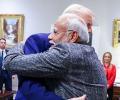
One must wonder whether Mr Modi's efforts to wine and dine the Big Two of today's world were seen as a sign of weakness rather than a proffered arm of friendship, points out R Jagannathan.

India reasserted that Pakistan requested a cessation of firing via DGMO contact and addressed concerns about Pakistan's roles in UNSC committees.

The matter would be heard by Chief Justice B R Gavai and Justice Augustine George Masih.
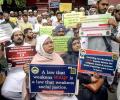
'The new Waqf bill sows the seed for conflict in every town and village of India.'
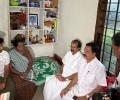
Two Union Ministers visited the family of a 23-year-old woman in Kothamangalam who allegedly took her own life due to harassment by her lover. The family is demanding an NIA probe into the incident, alleging forced religious conversion.

The Supreme Court of India began hearing a batch of petitions challenging the constitutional validity of the Waqf (Amendment) Act, 2025. The bench, led by Chief Justice Sanjiv Khanna, asked both sides to address whether the court should entertain the petitions or relegate them to the high court. The hearing is underway with senior advocate Kapil Sibal arguing for the petitioners. The act, which was passed by Parliament following heated debates, has been challenged by various parties including AIMIM leader Asaduddin Owaisi, All India Muslim Personal Law Board (AIMPLB), and Jamiat Ulama-i-Hind.

Despite ongoing tension between the two countries on the issue of extremism, Bezirgan said he expects warmer ties henceforth as Carney has invited Prime Minister Modi for the G7 Summit.

The Muslims are troubled due to the prevailing conditions and worried about their future," Bukhari said.

The Republican Party of India-Athawale leader said that removing Aurangzeb's tomb would not solve anything.

The United States has extradited Pakistani-Canadian Tahawwur Hussain Rana to India to face charges for his alleged involvement in the 2008 Mumbai terrorist attacks. Rana, 64, was convicted in the US in 2011 for providing material support to Lashkar-e-Taiba, the Pakistani militant group responsible for the Mumbai attacks. The US Department of State said it has long supported India's efforts to bring those responsible for the attacks to justice and that the extradition is a critical step towards seeking justice for the victims. Rana's extradition comes after the US Supreme Court denied his last-ditch attempt to evade extradition. He will now face justice in India for his role in the attacks which killed 166 people, including six Americans.

'The quality of justice is directly linked to the quality of judges -- if that suffers, justice delivery suffers.'

The execution of Nimisha Priya, an Indian nurse on death row in Yemen, has been postponed by Yemeni authorities, sources said on Tuesday.
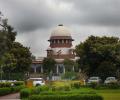
The bench, which asked Jain to withdraw the plea filed against a Delhi high court order that dismissed a writ petition challenging the registration and recognition of the AIMIM by the Election Commission (EC), granted liberty to the petitioner to file a writ petition, wherein he may make a wider prayer for reforms in respect of political parties on different counts.
The Supreme Court of India will likely hear a batch of petitions challenging the constitutional validity of the Waqf (Amendment) Act, 2025 on April 15. The Act, which came into force on April 8, has been met with widespread criticism from various stakeholders, including politicians, the All India Muslim Personal Law Board (AIMPLB), and Jamiat Ulama-i-Hind. They argue that the law is discriminatory and violates the fundamental rights guaranteed under Articles 25 and 26 of the Constitution. The petitions allege that the amendments give the government more control over the administration of Waqf, effectively sidelining the Muslim minority from managing their own religious endowments.

The Varanasi district court arrived at the decision of allowing 'puja' in a Gyanvapi mosque cellar in "haste", the All India Muslim Personal Law Board (AIMPLB) said on Friday, asserting it would pursue the matter right up to the Supreme Court.

'Arundhati Roy is like a ballerina performing on a high wire, cool, supremely at ease but conscious of all the adoring eyes on her,' notes P Vijaya Kumar.

If Rahul's yatra makes a political statement from the other side of the aisle and Shah Rukh's success underlines a more relaxed popular mood, Mr Modi and Mr Bhagwat's cues to their followers are coming from another place, observes Shekhar Gupta.

'Pakistan cannot sustain a war with India for more than four days. They are in such dire straits. At best they can sustain war for one week.'

Acutely conscious that he's left with less than four years to create his legacy, Trump is undoubtedly a man in a hurry, observes Ambassador M K Bhadrakumar.

The Congress has not released a poll manifesto but a declaration of appeasement.

The incident has brought back into focus the controversy that erupted last year when BJP-led governments in Uttar Pradesh and Uttarakhand directed food outlets along the Kanwar route to display the names of their owners and staff.

The All India Muslim Personal Law Board (AIMPLB) has called for a nationwide 'lights out' protest from 9 PM to 9:15 PM on April 30 to oppose the amendments made to the Waqf Act. The AIMPLB spokesperson, SQR Ilyas, stated that the protest is a symbolic expression of solidarity against the 'discriminatory and constitutionally incompatible' amendments. The Board has been running a campaign against the amendments since April 10, organizing meetings and protests across the country.
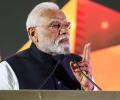
Prime Minister Narendra Modi hailed the passage of the Waqf (Amendment) Bill in Parliament as a "watershed moment" in the country's quest for socio-economic justice, transparency and inclusive growth. He said the legislation will particularly help those who have long remained on the margins, thus being denied both voice and opportunity. Modi stated that the Waqf system was synonymous with lack of transparency and accountability, especially harming Muslim women, poor Muslims and Pasmanda Muslims. He added that the legislation will boost transparency and safeguard people's rights, ushering in a more modern and socially just framework. The prime minister thanked all members of Parliament and the public for their contributions to the legislation.

Security agencies in Jammu and Kashmir are facing a new threat from 'bedroom jihadis' who use social media to spread misinformation and incite communal discord. These individuals, operating from their homes, are part of a sophisticated cross-border effort to destabilize the region by disseminating inflammatory content and propaganda.

National Conference vice president Omar Abdullah said notifying the rules for the CAA days before the announcement of the Lok Sabha elections shows the Bharatiya Janata Party is not confident about winning 400 seats in the ensuing polls.
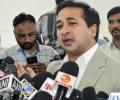
Maharashtra minister Nitesh Rane criticizes Uddhav and Raj Thackeray's joint rally, calling it divisive and anti-Hindu. Senior BJP leader Sudhir Mungantiwar offers a more conciliatory view.

Visuals of Jammu and Kashmir Chief Minister Omar Abdullah scaling the gate of the Naqshband Sahib graveyard and jostling with securitymen deployed there have gone viral.

The Pakistan government, as well as the country's military establishment, have come under severe criticism from netizens on social media for recommending United States President Donald Trump for the Nobel Peace Prize.

This came after a media report claimed that Col Qureshi and Wing Commander Singh, who led India's press briefings on Operation Sindoor, will be the faces of an ambitious women-centric campaign to be rolled out by the BJP on the completion of 11 years of the Modi government on June 9.

A three-judge Supreme Court bench will hear petitions challenging the constitutional validity of the Waqf (Amendment) Act, 2025, on April 16. The petitions, including those by politicians and the All India Muslim Personal Law Board (AIMPLB) and Jamiat Ulama-i-Hind, were filed in the top court challenging the validity of the newly-enacted law. The Centre has filed a caveat in the apex court, seeking a hearing before any order is passed.

Yogi said Waqf boards have become a den of selfish interests as well as loot khasot (property grabbing), and have done little for the welfare of Muslims.

The court said the judiciary showing tolerance towards matters with anti-national overtones is leading to a rise in the number of such cases.

'BSP will remain a player, but only a marginal player, as long as the BJP is extremely dominant in North India politics.'
Last-minute efforts are underway to halt the scheduled execution of an Indian nurse in Yemen, with a Sufi scholar leading negotiations with the victim's family.

Prime Minister Narendra Modi asserted on Tuesday that India's water will no longer flow outside the country but will be utilized in the nation's interest, a statement seemingly directed at Pakistan following his government's decision to put the Indus Waters Treaty in abeyance after the Pahalgam terror attack. Addressing the ABP Network's 'India@2047' Summit, Modi emphasized his government's focus on interlinking rivers, noting that water used to be a source of conflict among states, before alluding to India's stance against Pakistan while discussing water. He highlighted the finalization of the India-UK free trade agreement as a historic milestone and underscored the importance of prioritizing national interest for achieving objectives and realizing the country's potential. Modi highlighted the country's growth and development under his government's rule, emphasizing its focus on welfare schemes and digitalization. He reiterated his government's commitment to 'Nation First' and pointed to the recent reforms undertaken, including the new Waqf law and the ban on triple talaq, which he said were aimed at benefiting the marginalized sections of society.
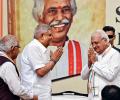
What piques the narrative is that Prime Minister Narendra Modi and Union Home Minister Amit Shah decide on crucial matters, they play it close to their chest, and revel in springing a surprise.

'For Muslims, India is now a Hindu Rashtra, no matter what kind of Constitution is still in place,' argues Mohammad Sajjad.
